


If you are a sole trader using Making Tax Digital for Income Tax, you will need to know whether you are using cash basis or traditional accounting to keep your records. The important thing is that Making Tax Digital does not force you to use one method over the other. Since 6 April 2024, cash basis has been the default method of accounting for sole traders and partnerships without corporate partners. If you’re a sole trader or partnership that qualifies for the cash basis but think traditional accounting is a better fit for your business, then you may choose to use traditional accounting instead.
TL;DR: cash basis or traditional accounting?
For most sole traders, cash basis is now the default, with no turnover limit for trading businesses. You record income when you receive it and expenses when you pay them. Traditional accounting records income and expenses according to when they are invoiced or billed.
You don’t have to switch to traditional accounting with Making Tax Digital for Income Tax.The way you do this will influence how you keep your digital records and how transactions are reflected in your MTD figures.
What is cash basis accounting?
Cash basis accounting is when you recognise income when it is received and expenses when they are paid. HMRC says with cash basis accounting you only pay tax on the income you actually receive.
For example, if you send an invoice in March but your customer does not pay you until April, you normally record that income in April. HMRC gives a similar example: if you invoice a customer on 15 March 2024, but they do not pay you until 30 April 2024, the income is recorded on 30 April.
The same principle applies to expenses. If you receive a bill in March but do not pay it until May, you generally record the expense when you pay it. This can make cash basis relatively straightforward for sole traders who want their accounting records to follow the money actually moving in and out of their business.
What is traditional accounting (accruals basis)?
Traditional accounting records income and expenses according to when they are earned or incurred, rather than simply when the money is received or paid. This is also called the accruals basis by HMRC.
For instance, imagine you complete some work and invoice a customer for £5,000 on 25 March. They pay you on 15 April. Under cash basis, the £5,000 would normally be recorded when you receive the payment in April. Under traditional accounting, the income relates to the accounting period in which it was invoiced, even though the customer pays you later. Traditional accounting can therefore involve additional calculations for things such as unpaid invoices, unpaid bills, stock, accruals, and prepayments.
Cash basis vs traditional accounting: what’s the difference?
The main difference between cash basis and traditional accounting is when income and expenses are recognised.
| Description | Cash basis | Traditional accounting (accruals basis) |
|---|---|---|
| Income | Recorded when received. | Recorded when earned or invoiced |
| Expenses | Recorded when paid | Recorded when incurred |
| Outstanding invoices | Recorded when you get paid | Recorded when earned or invoiced |
| Stock | Simpler treatment may apply. | May require accounting adjustments |
| Year-end adjustments | Generally fewer | Accruals and prepayments may be needed. |
From the 2024/25 tax year, the £150,000 entry limit and £300,000 exit limit for trading businesses were removed. The previous £500 restriction on interest deductions and specific cash basis restrictions on trading loss relief were also removed.
Which method do you need for Making Tax Digital?
MTD for Income Tax does not require you to use traditional accounting.
If you are eligible for cash basis, you can continue using it when keeping your digital records.
If you use standard update periods, your quarterly updates are cumulative and are due on 7 August, 7 November, 7 February, and 7 May.
You do not need to make accounting or tax adjustments before sending each quarterly update.
After the fourth update, however, traditional accounting users may need to make year-end adjustments for things such as accruals and prepayments before completing their tax return. These particular adjustments are generally not required under cash basis.
Here is an example. Let's say Priya is a freelance designer who is already required to use MTD for Income Tax. During the 2026/27 tax year, she invoices £60,000.Of this, £6,000 is invoiced in March 2027 but paid in April 2027. £4,000 was invoiced in the previous tax year but paid in April 2026. She pays £11,000 of business expenses relating to 2026/27 during the year. She also receives a £1,000 printing bill relating to March 2027 but pays it in May 2027.
Here's the difference:
| Description | Cash basis | Traditional accounting (accruals basis) |
|---|---|---|
| Income | £58,000 | £60,000 |
| Expenses | £11,000 | £12,000 |
| Taxable profit | £47,000 | £48,000 |
Under cash basis, the invoice of £6,000 is recorded in the next tax year when Priya receives the payment. The £1,000 printing charge again appears in the next tax year, when she pays it off.
Under traditional accounting, both fall in the 2026/27 accounting cycle. The £1,000 difference is mostly a time variation, not a permanent £1,000 reduction in taxable profit. Under cash basis, the records follow when the money is actually received or paid.
Why do some businesses use traditional accounting?
Traditional accounting provides a different view of business income and expenses, recording transactions when they are earned or incurred, rather than when payment occurs. This implies records can even include delinquent customer invoices, unpaid supplier bills, stock accruals, and prepayments. Some businesses also may create traditional accounting for external reporting purposes (e.g., information required by a lender).
Not all businesses can use the cash basis. For example, it cannot be used by limited companies, limited liability partnerships and partnerships which include corporate partners. HMRC also excludes some specialist businesses.
If you're unsure which accounting method applies to your circumstances, speak to an accountant or tax adviser.
What about landlords?
There is an important exception to the removal of the £150,000 limit.
The turnover limit has gone for eligible trading businesses, but separate rules still apply to property businesses.
Cash basis is generally the default for qualifying individual property businesses where property receipts are £150,000 or less. If receipts exceed £150,000, traditional accounting will normally be required.
How does this work with AbraTax?
If you keep your MTD records in a spreadsheet, AbraTax can bridge your digital records to HMRC.
You prepare the relevant cumulative income and expense totals from your records, link the required categories to the AbraTax template, upload your CSV, review the figures, and submit your quarterly update.
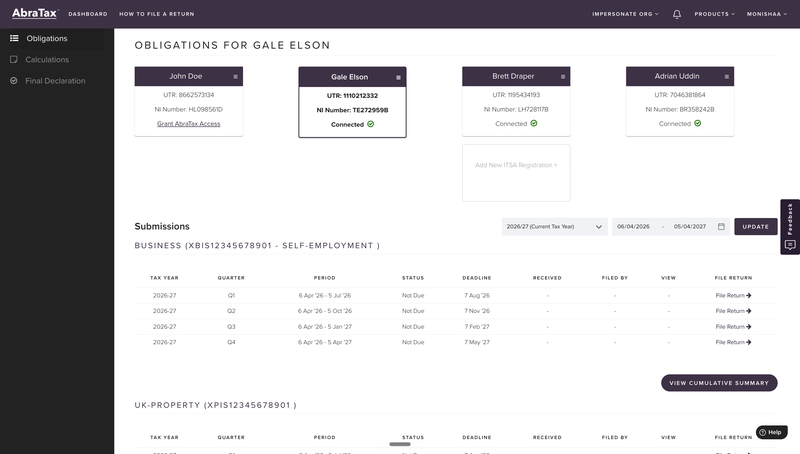
Remember that your quarterly update is a summary of your digital records. It is not your final tax return.
See how to submit an MTD quarterly update using AbraTax.
Ready for Making Tax Digital?
Whichever accounting method you use, MTD for Income Tax requires you to keep the required digital records and use compatible software to send information to HMRC.
Already keeping records in spreadsheets? AbraTax lets you connect your spreadsheet records to HMRC without moving to a full accounting package.